Studiox — Creative Agency Next.js Template
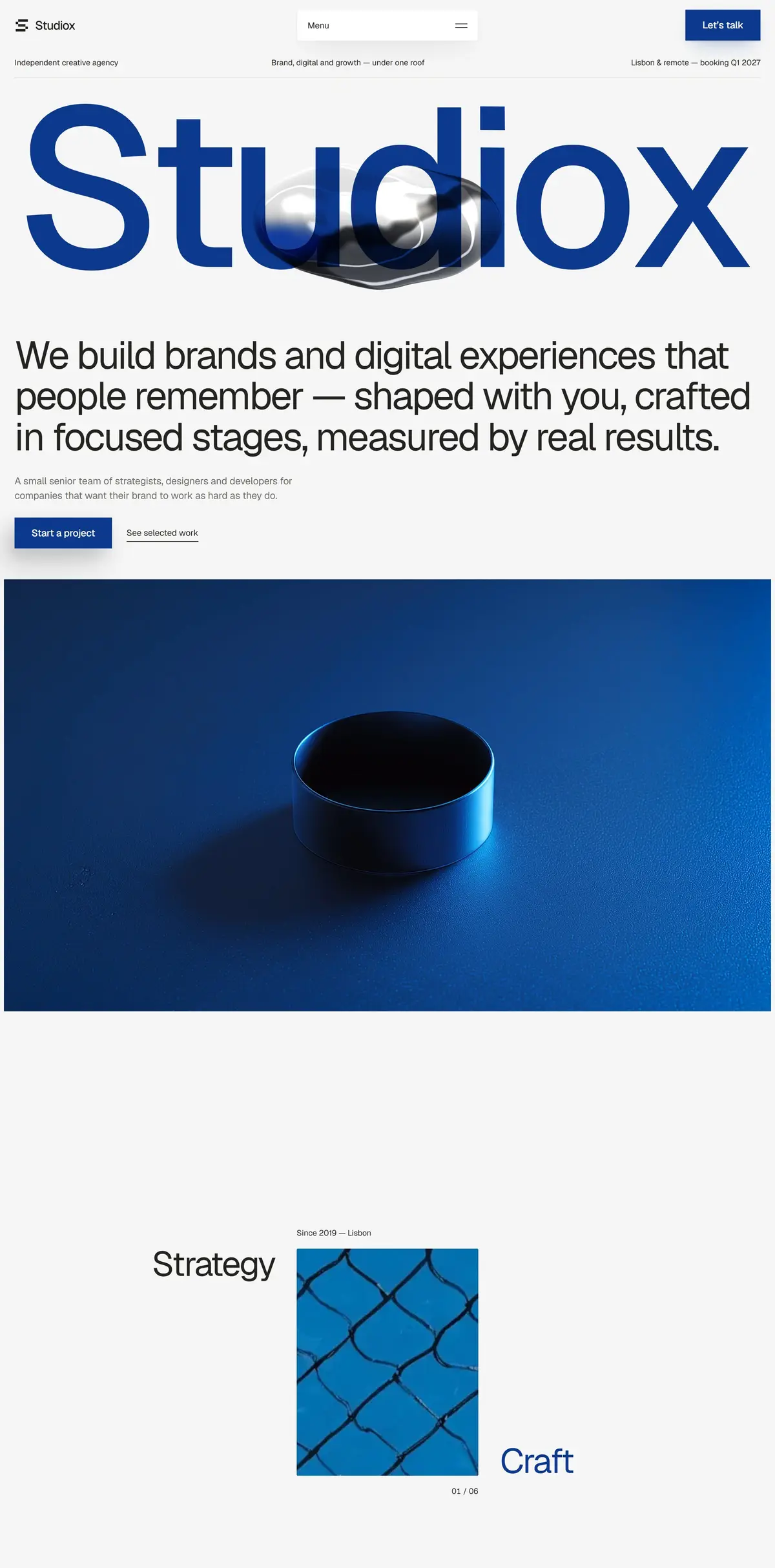
A calm, editorial Next.js template for creative agencies, with a liquid-chrome hero, a kinetic wordmark and work, journal and team pages in Markdown.
Or get this and every other template for $99 with the All-Access Pass.
About this template
Studiox is a calm, editorial Next.js template for independent agencies, design studios and freelancers who want a site that feels considered, not loud. Large Geist type, one cobalt accent and plenty of white space keep the focus on the work. A real-time liquid-chrome hero and a kinetic wordmark give it character from the first scroll.
It is built with Next.js 16 (App Router, every route prerendered), React 19, TypeScript, Tailwind CSS v4, GSAP and Lenis.
Pages
- Home: 16 sections, including the chrome hero with an expanding video, a scroll-driven image zoom, a services list with a hover preview, selected work, client logos, a four-step process, animated stats, a draggable team track, awards, a testimonial deck, pricing, journal, FAQ and a contact form
- About: the studio's story, values and team
- Services: four disciplines and the working process
- Work: all projects in one view
- Project page: one detail page per Markdown file (four included), with the challenge, approach, results and gallery
- Journal: all articles
- Article: one page per Markdown file (three included)
- Team member: one page per Markdown file (ten included), with a bio and focus areas
- Pricing: two plans and what is always included
- Contact: an enquiry form with service and budget choices
- Privacy Policy
- 404
Built in
- Liquid-chrome hero: a WebGL shape that follows the cursor.
- Kinetic wordmark: the letters of the name swell as the cursor passes over them.
- Crosshair cursor: thin lines and a label that changes per section, on mouse devices.
- Intro loader and page transitions: the logo mark builds itself once per visit, and a curtain carries the page label between routes.
- Scroll motion: GSAP ScrollTrigger drives the image zoom, line-by-line headline reveals, image reveals and pixel edges that dissolve between sections.
- Testimonial deck and team track: drag the quotes to shuffle them, and drag the team sideways.
- Counters and pixel stats: numbers roll with NumberFlow while a grid of cells fills in.
- Smooth scrolling with Lenis, and a menu with a clip reveal and staggered links.
- Reduced motion: the site respects the visitor's reduced-motion setting and shows every section in place.
Easy to edit
- Email, navigation, footer and social links live in
src/data/site.ts. Home text is insrc/data/home.ts, and the other pages are insrc/data/pages.ts. - Adding one Markdown file to
src/data/projects/,src/data/blog/orsrc/data/team/creates its page and adds it to the lists. Services work the same way insrc/data/services/, without a page of their own. - Colours and the font token are in one file,
src/styles/variable.css, and the type styles are insrc/styles/typography.css. Geist loads fromsrc/utils/font.tsthroughnext/fontand is served from your own site. - Server components render the content; client code runs only where something moves or responds.
- SEO is set up: per-page titles and descriptions, canonical URLs, Open Graph tags, a generated
sitemap.xmlandrobots.txt, and images throughnext/image.
Good to know
- Images: the photos and hero video in the download are placeholders at the exact size the design uses, labelled with their size. Swap in your own.
- Forms: the contact form checks its fields in the browser, then opens the visitor's email app with the message filled in. There is no backend.
- Hosting: every route is prerendered. Deploy to Vercel with no settings, any Node host (
bun run build && bun run start), or Cloudflare Workers with the included OpenNext setup. - Requirements: Node.js 20.9 or newer. npm and Bun both work.
The included documentation walks through setup, content, colours, images, animations and deploying.